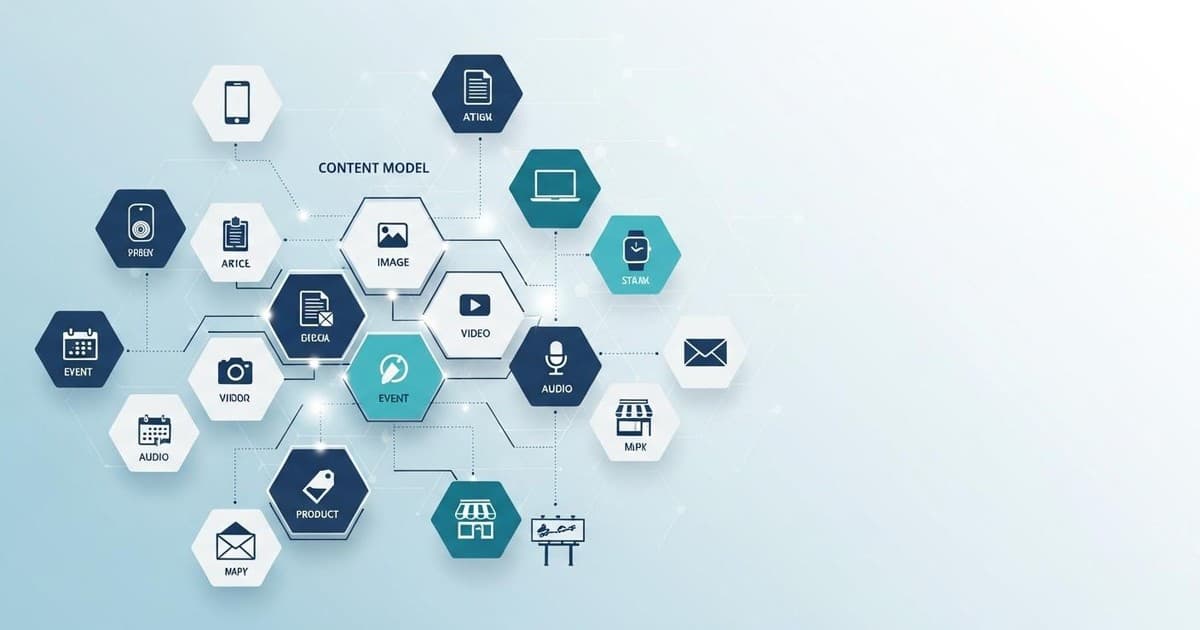
The Benefits of Content Models for Omnichannel Marketing

Creating and managing content for your website, mobile app, email campaigns, and social media feels like a constant, repetitive struggle. You're not alone—this chaos is exactly what happens when businesses try to deliver the omnichannel promise of seamless, consistent customer experiences across all touchpoints using traditional, page-based content management systems.

Here's the reality: implementing content models is the foundational shift required to move from chaotic content creation to an efficient, scalable, and truly omnichannel marketing engine. Let me show you exactly how this transformation works and why it's essential for your business.

Why Traditional Content Workflows Create Omnichannel Chaos

Image representing Why Traditional Content Workflows Create Omnichannel Chaos

The problem starts with content silos. When you create a webpage, that content gets trapped in the webpage's HTML structure. Your social media team then copies and pastes portions for their posts, your email team reformats it for newsletters, and your mobile app developers recreate it entirely for in-app messaging.

This approach creates three critical problems:

  • Inconsistent customer experiences: Different teams recreating content for their specific channels leads to variations in messaging, tone, and even factual information
  • Massive resource waste: Teams spend countless hours copying, pasting, and reformatting the same core information for different platforms
  • Zero agility: Launching on new channels like voice assistants or smartwatches means recreating all content from scratch

If you're wondering when is the right time to have a CMS that solves these issues, the answer is now—before these inefficiencies compound further.

Content Models: Your Blueprint for Structured Content

Image representing Content Models: Your Blueprint for Structured Content

A content model is a structured blueprint that breaks content down into its smallest reusable parts, completely independent of how it will be displayed. Think of it like LEGO blocks—you create standardized "blocks" (headlines, images, product descriptions) that can be assembled in different ways for different channels.

Content models consist of two key components:

  • Content Types: Main categories like Article, Product, Event, or Author
  • Attributes/Fields: Individual pieces of information within each type (an "Article" has a "Headline," "Body Text," "Author," "Publish Date")

This differs completely from page templates. Templates control presentation (the "look"), while content models control the underlying structure and substance of information itself.

The Five Core Benefits of Content Models for Omnichannel Marketing

Image representing The Five Core Benefits of Content Models for Omnichannel Marketing

1. Massive Efficiency with COPE (Create Once, Publish Everywhere)

A single piece of structured content automatically deploys to your website, app, email campaigns, and social media. This approach reduces manual work by up to 70%, minimizes errors, and dramatically speeds up time-to-market for new campaigns.

2. Unbreakable Brand and Message Consistency

Content models create a single source of truth for every piece of content. Your customers receive identical information and brand voice everywhere they encounter your business. When you need updates, make them in one place and watch them propagate across all channels instantly.

3. Future-Proofing and Scalability

Adding new channels becomes simple—you just build a new presentation layer that pulls from existing structured content. This prepares your content strategy for technologies you haven't even considered yet, from AR/VR experiences to IoT devices.

Modern agentic CMS platforms versus traditional CMS solutions make this scalability possible through intelligent content distribution.

4. Personalization at Scale

Structured, tagged content becomes easier for systems to understand and assemble dynamically. This enables delivering the right content component to the right person on the right channel at exactly the right time, without manual intervention.

5. Improved SEO and Machine Readability

Content models naturally align with structured data formats that search engines love. This makes your content easily understandable not just for Google, but also for voice assistants and other AI-driven platforms that increasingly drive customer discovery.

Real-World Example: Modeling a Product Promotion

Image representing Real-World Example: Modeling a Product Promotion

Let's model a "Product Promotion" content type with these attributes:

  • Promotion Name (Short Text)
  • Product Name (Reference to "Product" content type)
  • Discount (Percentage or Fixed Amount)
  • Promotional Image (Media File)
  • Short Description (Plain Text, for social/SMS)
  • Long Description (Rich Text, for web/email)
  • Start Date & End Date (Date/Time)

This single content model powers multiple channels simultaneously:

  • Website Homepage Banner: Uses Promotional Image, Promotion Name, and link
  • Mobile App Push Notification: Uses Short Description and Product Name
  • Email Newsletter: Uses Promotional Image, Long Description, and Discount
  • Social Media Post: Uses Promotional Image and Short Description

Getting Started with Content Modeling

Image representing Getting Started with Content Modeling

Begin with a content audit—identify your key business objects and their associated information patterns. What content do you create repeatedly? Start with 3-5 essential content types like Blog Post, Product, or Case Study.

For each type, map out required attributes. A "Blog Post" might need Headline, Author, Body, Featured Image, Tags, and Publish Date. Keep it simple initially.

The technology choice matters significantly here. Agentic CMS platforms with AI workflow integration provide the ideal foundation for managing structured content across multiple channels seamlessly.

Start small and iterate. Don't attempt to model your entire organization immediately. Pick one content area, prove the value, then expand systematically.

Shift Your Mindset from Pages to Content

Image representing Shift Your Mindset from Pages to Content

Winning at omnichannel marketing requires stopping the practice of creating "webpages" and starting the practice of creating structured, reusable "content." This isn't just a technical exercise—it's a strategic business decision that builds a resilient and agile content engine for whatever the future brings.

The benefits are clear: massive efficiency gains, unbreakable consistency, and unlimited scalability. Content modeling transforms your marketing operations from reactive chaos into proactive strategy.

Ready to start? Begin your first content audit today. Identify one content type you create frequently and map out its core attributes. Your omnichannel future starts with this single step.

Related Articles